
I work at the Harvard Film Archive twice a week, but calling it work would be unfair. It’s about 10% administrative and 90% catching snippets of screenings. HFA’s theater is located underground, and movies are $5 and open to the public. Some days, every seat next to me is filled; other times, none are. Either Bresson or Herzog (maybe both, maybe neither) said once that we go to the cinema to be alone. It is true, we watch movies for a few hours of sublime solitude. But we watch movies so the hours before and after them can be a little less lonely, so that we might travel when we can’t. I watched Jiang Wen’s In the Heat of the Sun when I was 15 to try and grow up alongside my parents. I sometimes dream of the Persian landscape, as if I’ve lived there, because of the films of Abbas Kiarostami.
The Oscars last Sunday awarded Bong Joon-Ho’s Parasite Best Picture, the first foreign-language film to win this category and the 13th to be nominated. It sparked dialogue around the act of reading a movie as opposed to watching it, and subsequent praise has been given to the Motion Picture Academy. Finally, they said, the merit of foreign language film is recognized.
I, alongside many who have grown up with films in other languages, our own languages, recognize that Parasite’s historic win is merely Hollywood catching up. That the absence of foreign language films from the gold-clad awards show isn’t a marker of their insignificance, but of Hollywood’s. Ultimately, the most notable moment of the night was the five seconds Bong spent onstage, gazing at his glistening statues.
I went into Parasite largely a skeptic: the Palme d’Or (the Cannes Film Festival’s highest honor which was awarded to the film last May) has often felt like more of a prize for lifetime achievement of the director than for the individual films themselves. Before Parasite, there was Bong’s Okja (2017) and Snowpiercer (2013): films that dealt with similar themes but fell short of actually presenting much, morally or aesthetically—maybe it was Tilda Swinton’s performance, reminiscent of her cameo in Joan Jonas’ 1989 absurdist short-film Volcano Saga, where she plays a forest nymph. Or maybe it was that the story centered on taking a pet from a child. Or maybe it was Jake Gyllenhall.
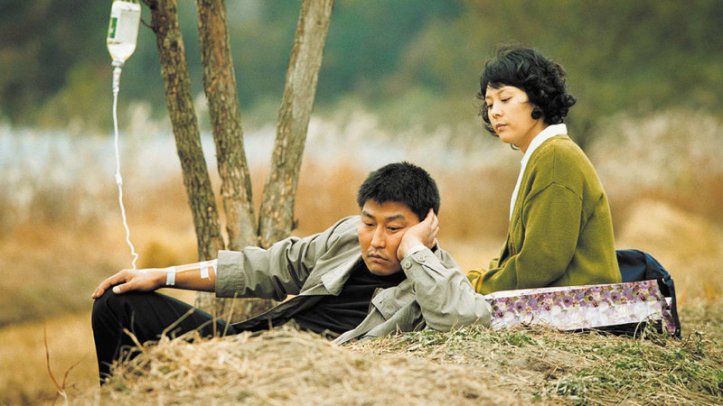
Yet, moments into the screening, I had joined the ranks of Bong-converts. My mind raced with posterior revelations—the film had made me an adrenaline junkie. I wanted to stroke every rock I passed, walk into the brownstones neighboring the IFC Center in Greenwich Village, and eat from their pantries. I wanted to watch it twice over but instead committed to watching all of Bong’s previous films, pining for a similar, almost destructive overstimulation. Memories of Murder, Bong’s second feature, is a 2003 crime-drama starring a younger Song Kang-ho (who plays the father in Parasite) that is at times almost unrecognizable as part of the Bong corpus. It trades Parasite’s immaculate modern mansion for pedestrian backdrops: a run-down ramen shop, wilting grass on the sides of a train track, a municipal police office bathed in fluorescents, each site baleful in its neutrality. The horrors in Parasite don’t just sneak up, they are splattered across the screen. In Memories, the horror is at the core of the film, but perpetually out of reach. It is based on the true story of a slew of serial murders (the first in Korea’s history) that shook the small town of Gyeonggi Province in the late ‘80s. It centers on the repeated shortcomings of a classic ill-fated detective duo with a Rush Hour dynamism. In the end, their investigation proves futile and the two separate, with Song becoming an electronics salesman. Memories is nowhere near lethal in its pacing, more background music than the symphony that is Parasite. The killer is said to only act on nights when there’s rain, so many scenes are cloaked in a murky color—it seems we are trudging through mud. However, where it does fall similar to Parasite ultimately spotlights a crucial aspect of what makes Bong, as critics have hailed, a “genre onto his own.” In both films, Bong does not invent new sensation but instead teases out the amusement and titillation of the quotidian—the jaded, often unremarkable realities of everyday life. In Parasite, it is not the lives of the rich and the poor that are the cause for thrill, but the satirical consequences of economic inequality. Just as Memories is not a biopic in which a teen heartthrob grows up to be Ted Bundy; it is a sardonic portrait of a provincial police team, who are themselves often unsure of the grave responsibility placed on them. In Memories, and then in Parasite, Bong believes there is never a need to imagine clowns or charlatans. His characters, though absurdly cruel and perpetually self-obsessed, could very much be me, or you.
 Code Unknown